Colour, precision, and modern pastry craft
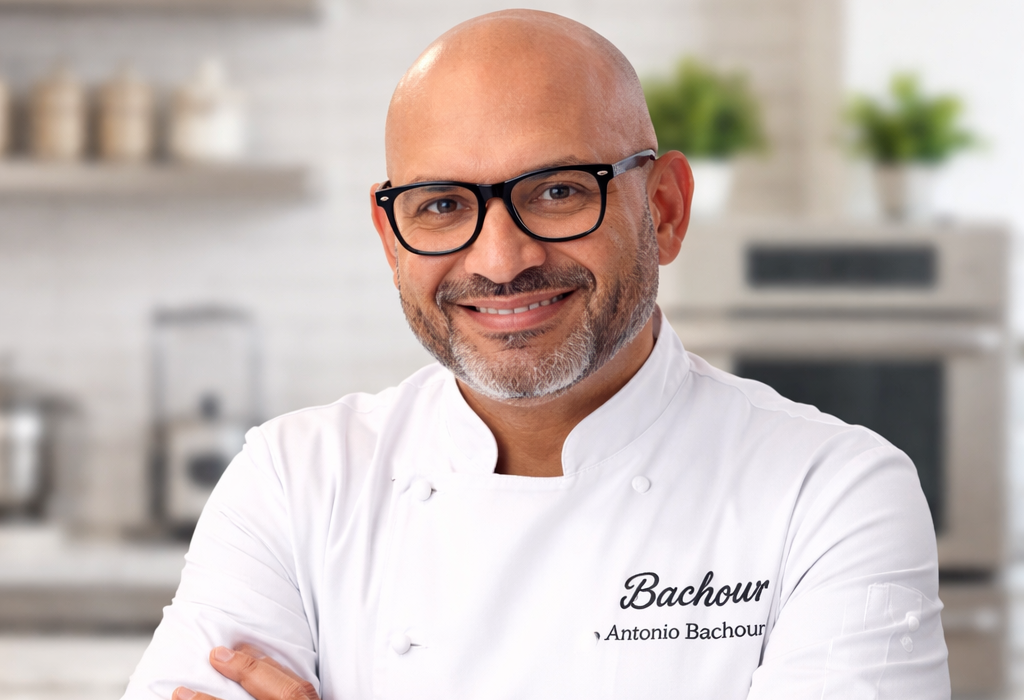
Antonio Bachour was born in Puerto Rico, a place where food, colour, and hospitality are part of everyday life. That environment shaped his early relationship with pastry. Baking was not something distant or formal. It was practical, expressive, and connected to people. That grounding still shows in his work today, no matter how refined or technical it becomes.
Bachour’s professional training took place in the United States, where he studied at Johnson and Wales University. This gave him a strong classical foundation and exposure to modern pastry techniques. From there, his career moved quickly through high-level kitchens, including luxury hotels where consistency, speed, and precision matter every day. These environments refined his discipline and pushed him to develop a style that could be repeated without losing creativity.
His signature creations are instantly recognisable. Bachour is best known for his sculptural entremets, often built with clean lines, bold colours, and layered textures. These desserts are visually striking, but they are not decorative for the sake of it. Each element has a purpose. Acidity balances sweetness. Crunch offsets softness. Colour signals flavour rather than distraction. The result is pastry that feels modern while remaining grounded in technique.
One of the reasons Bachour stands out is his ability to translate complex ideas into clear systems. His books and classes focus on structure, balance, and repeatability. This makes his work accessible to professionals rather than mysterious or unattainable. He teaches how to build desserts properly, not just how to copy shapes or finishes.
As an international trainer, Bachour has influenced pastry kitchens far beyond his own. He travels widely, teaching chefs across Europe, Asia, the Americas, and Australia. His approach encourages chefs to think visually, but also to respect flavour and texture above all else. Many younger pastry chefs credit his work with helping them understand how modern pastry can be expressive without losing control.
Antonio Bachour’s legacy lies in his role in shaping contemporary pastry into a discipline that values clarity. He showed that colour need not mean excess, and that technical refinement need not require rigidity. His work bridges craft and creativity in a way that feels generous rather than intimidating.
For today’s pastry chefs, Bachour represents a turning point. He helped move pastry forward without rejecting its foundations. That balance is why his influence continues to grow, not just through his desserts, but through the many chefs who now think more carefully about how pastry should look, taste, and feel.