
Mochi ( Japan)
February 5, 2026
Dorayaki
February 10, 2026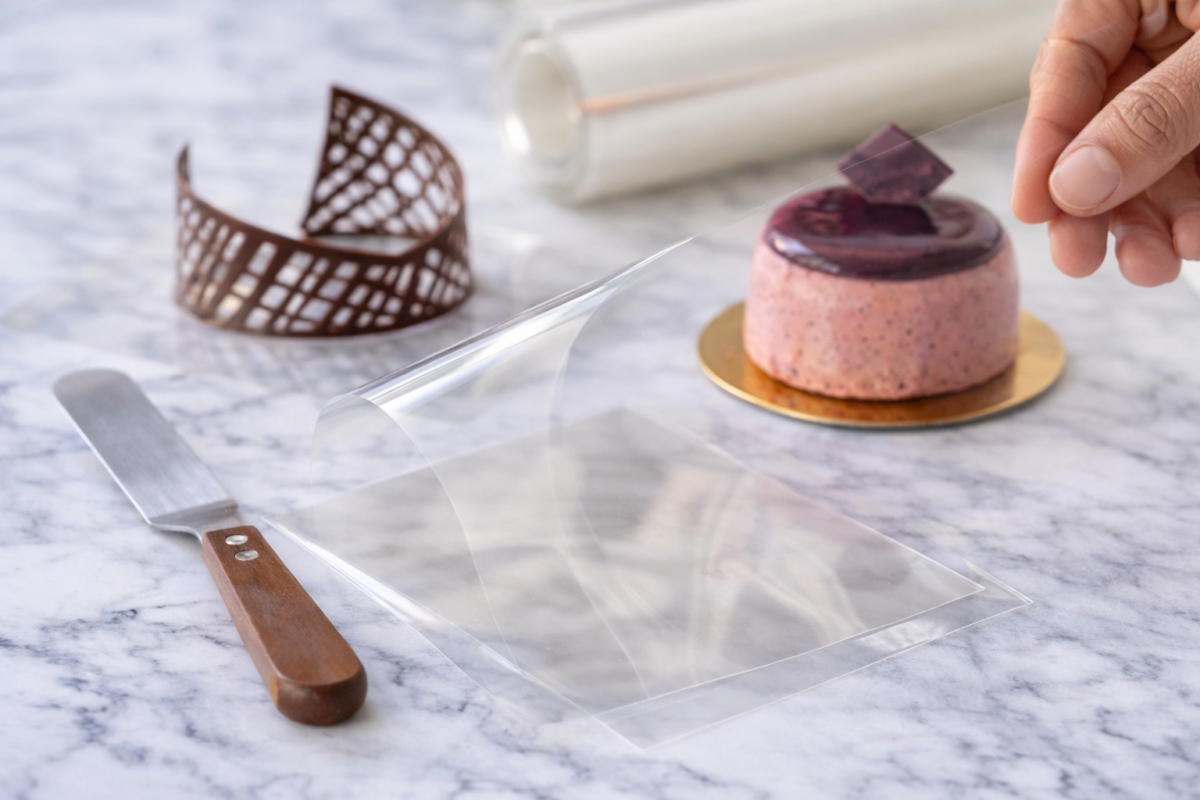
For chocolate decorations and clean mousse cake edges
Some pastry tools feel technical until you use them once. Acetate sheets fall firmly into that category. They are simple, inexpensive, and unassuming, yet they quietly solve problems that even experienced home bakers find frustrating.
If you enjoy working with chocolate, mousse cakes, or modern plated desserts, acetate sheets are one of those tools that can instantly lift the finish of your work. They help you achieve clean edges, smooth surfaces, and sharp lines that would be difficult to achieve without professional equipment.
As a pastry chef, I think of acetate as a control tool. It gives structure where mixtures are soft, and it creates separation between dessert and mould, so everything releases cleanly. Once you understand how it behaves, it becomes something you reach for instinctively.
What are acetate sheets?
Acetate sheets are thin, flexible strips or sheets of clear, food-safe plastic. They are smooth on both sides and resistant to moisture, fat, and temperature changes. Unlike baking paper, acetate does not absorb flavours or wrinkle when exposed to chocolate or cream.
In professional kitchens, acetate is used everywhere. It lines cake rings, wraps mousse layers, supports chocolate décor, and helps chefs build desserts with precision. For the home chef, it offers the same advantages without the complexity.
Why acetate matters in modern pastry
Modern pastry often relies on contrast. Soft interiors, sharp edges, glossy surfaces, and defined layers. Acetate makes this possible.
When lining a cake ring with acetate, the dessert sets against a perfectly smooth surface. Once chilled or frozen, the acetate peels away without resistance, leaving a clean vertical edge that requires no trimming.
This matters most with mousse cakes, entremets, and layered desserts where the sides are meant to be seen. A rough edge can undo hours of careful work. Acetate prevents that problem before it starts.
Using acetate for clean mousse cake edges
The most common use of acetate at home is lining cake rings or springform pans.
You simply cut a strip of acetate slightly taller than your mould, then press it into place so it sits flush against the wall. The acetate acts as a barrier between the dessert and the mould, allowing the mousse or cream to set without sticking to the mould.
Once the dessert is chilled, the mould is removed first. The acetate is peeled away slowly, revealing a smooth, sharp edge that looks professional without extra effort.
This technique works just as well for cheesecake, no-bake cakes, and layered desserts that include biscuit bases and soft fillings.
Acetate sheets for chocolate decorations
Chocolate and acetate are natural partners.
When tempered chocolate is spread thinly onto acetate, it sets with a clean, glossy surface. This allows you to create shards, curls, bands, and panels with ease.
For simple decorations, chocolate can be spread and allowed to partially set before being cut or shaped. For more structured décor, chocolate can be wrapped around cylinders or moulds lined with acetate to form collars and rings.
The key advantage is release. Once the chocolate sets, the acetate peels away cleanly without damaging the surface. This is difficult to achieve with baking paper or silicone.
Controlling thickness and shape
One of the understated benefits of acetate is control.
Because it is rigid enough to hold shape but flexible enough to bend, it allows you to decide exactly how thick or thin a layer should be. This is especially useful when working with chocolate bands around cakes or layered inserts inside entremets.
In advanced home baking, consistency matters more than creativity. Acetate helps you repeat results, not just the experiment.
Acetate versus baking paper or silicone
Many home bakers try to substitute baking paper or silicone for acetate. Sometimes it works. Often it does not.
Baking paper absorbs moisture and fat, which leads to dull chocolate and uneven surfaces. It also creases easily, leaving marks behind.
Silicone is flexible but not rigid enough to support sharp edges in layered desserts. It can also trap air or create rounded edges where straight lines are needed.
Acetate sits between these options. It stays smooth, holds shape, and releases cleanly.
Choosing the right acetate
Acetate sheets come in different thicknesses and sizes.
For lining cake rings and making chocolate décor, thin sheets are usually sufficient. Thicker acetate can be useful for larger moulds or when more rigidity is needed.
Pre-cut strips are convenient, but buying sheets and cutting them yourself offers more flexibility. A sharp pair of scissors and a ruler are all you need.
Always ensure the acetate is food safe and designed for pastry work.
Cleaning and reusing acetate
Acetate sheets can be reused many times if properly cared for.
After use, wash them gently in warm water with mild detergent and dry them flat. Avoid high heat, dishwashers, or abrasive sponges, as these can warp or scratch the surface.
Scratches can transfer to chocolate, so keep sheets smooth and replace them once they show signs of wear.
Why acetate belongs in an advanced home kitchen
Acetate is not about decoration alone. It is about structure, control, and confidence.
Once you start using it, you will notice fewer compromises. Edges look intentional. Chocolate behaves predictably. Desserts feel finished rather than improvised.
For the advanced home chef, acetate sheets are not a shortcut. They are a way to respect the dessert you are making and present it as it deserves.
Frequently Asked Questions
Are acetate sheets food safe?
Yes. Acetate sheets sold for pastry use are food safe and designed to handle chocolate, cream, and cold temperatures.
Can I use acetate instead of baking paper?
Sometimes, but they serve different purposes. Acetate is best for clean edges and chocolate work, while baking paper is better for baking and lining trays.
Do acetate sheets need to be greased?
No. Acetate releases naturally and does not require grease.
Can acetate go in the freezer?
Yes. Acetate works well in chilled and frozen desserts and peels away cleanly once set.
How thick should acetate be?
Thin sheets work for most home uses. Thicker sheets are useful for tall cakes or large chocolate pieces.
Can I reuse acetate sheets?
Yes, as long as they are cleaned gently and kept smooth.
Why does chocolate look better on acetate?
Chocolate sits on a smooth, non-absorbent surface, helping it stay glossy and clean.
Related posts